
For most of the last century, finding a broken pipe meant digging until you hit it. Then someone bolted a television camera onto a set of wheels and sent it down a sewer. That small idea quietly rearranged an entire repair trade, and most property owners never noticed it happening.
The Camera Got There First
Closed circuit cameras started crawling through sewers around 1960, which makes the technology older than the pocket calculator. A company called CUES, grown out of a firm that had made its name repairing concrete on railroad bridges, began selling inspection systems to municipalities in the 1960s. Those early cameras stared straight ahead and nothing else. Useful, but stubborn.
The pan and tilt head arrived in the mid 1980s, after CUES worked with Benthos, a manufacturer of underwater remote operated vehicles. Sewer robots inherited their necks from deep sea machines, which is a strange piece of family history for something that spends its life in a storm drain. Once a technician could swivel the lens and study a crack instead of guessing at its location, the repair itself changed shape. Consider drain relining Mississauga projects: inspection footage helps contractors assess the damaged section, determine whether relining is suitable, and prepare a more accurate repair plan. Without video, the only honest option is to open the ground and look.
Excavation never disappeared. It simply stopped being the first move.
What the Robot Actually Sees
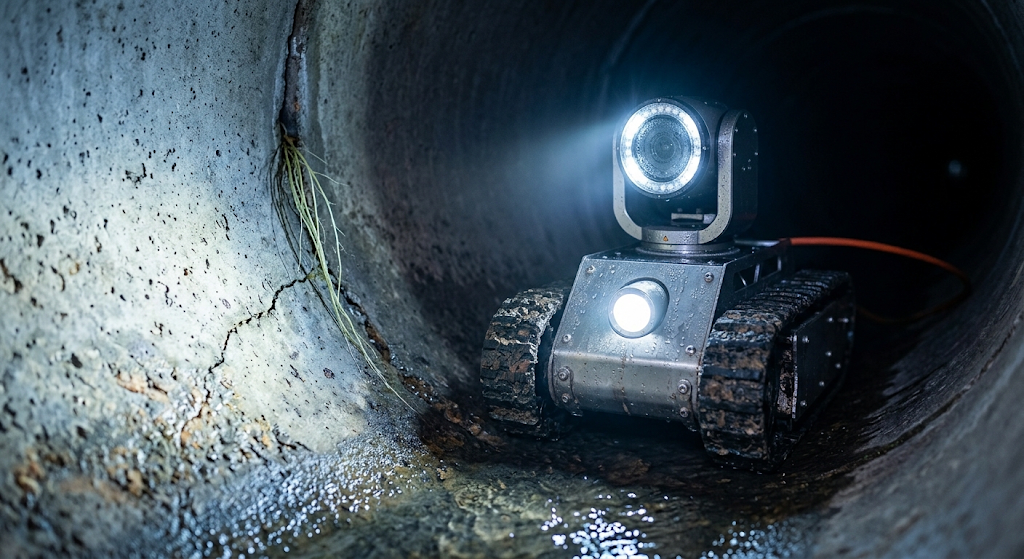
A modern crawler carries a high definition camera on a pan and tilt mount, its own lighting, and sometimes laser profiling or sonar for the parts sitting underwater. Lateral launch units go further. They park in the main line and fire a slim camera 100 to 150 feet into a service pipe as narrow as three inches, reaching private property without anyone touching the lawn.
The footage tends to turn up the same short list of villains, and they look much the same in any city.
- Roots feeding through a joint, thin as hair at first
- Offset joints where the ground shifted and the two halves stopped lining up
- Cracks, fractures and full collapses
- Scale and corrosion narrowing the bore
- A sag in the run, holding standing water that never drains away
- Cross bores, where somebody drilled a utility line straight through the sewer years ago
Across North America the findings get coded to the NASSCO PACP standard and graded from 1 to 5, with 5 meaning the failure is happening now rather than later. That grade is what turns a video into a decision.
Nobody Warns You About the Video
Here is the unglamorous part. Somebody has to watch all of it. In one research dataset, actual defects took up roughly 15 percent of the recorded footage, meaning a reviewer spends most of the shift watching clean pipe scroll past. Attention drifts. Would you catch a hairline fracture at hour six? Two technicians can watch the same joint and grade it differently.
AI review has moved into that gap. One inspection provider reports that coding time drops from upward of 16 hours per mile to about four, and claims 97 percent accuracy with certified staff signing off before delivery. That number comes from the vendor rather than an independent audit, so treat it as a vendor claim, not a settled benchmark. The shift in review work is real all the same.
Cameras also have a genuine blind spot. They cannot see through sludge or standing water, so the pipe gets flushed and cleaned before anything meaningful appears on screen.
Before You Book an Inspection
If a contractor is coming out with a camera, a few small requests will get you a far more useful result.
- Insist the line is cleaned first, otherwise you are paying to film mud.
- Ask for a PACP coded report rather than a verbal summary at the truck.
- Keep the raw video file. It becomes your baseline for every future inspection and quote.
- Have the crew mark defect depth and distance from a fixed point, such as the cleanout or the foundation wall.
Four small asks. They cost nothing and they change what the results are actually worth to you.
Why Digging Became the Last Resort
The economics did most of the persuading. Water damage now accounts for something close to half of home insurance claims in Ontario, roughly 40 percent or 48 percent depending on which report you trust, and the average flooded basement claim runs past $43,000 once cleanup and restoration are counted. Sewer backup claims across Canada land in a similar band.
Older parts of Mississauga and Etobicoke make the case sharper. Heavy clay soil, aging combined sewers and mid century homes with weeping tile connected straight into the sanitary line. A camera survey on that kind of property costs a rounding error against a finished basement.
Point a lens down the pipe first. The shovel can wait its turn.