
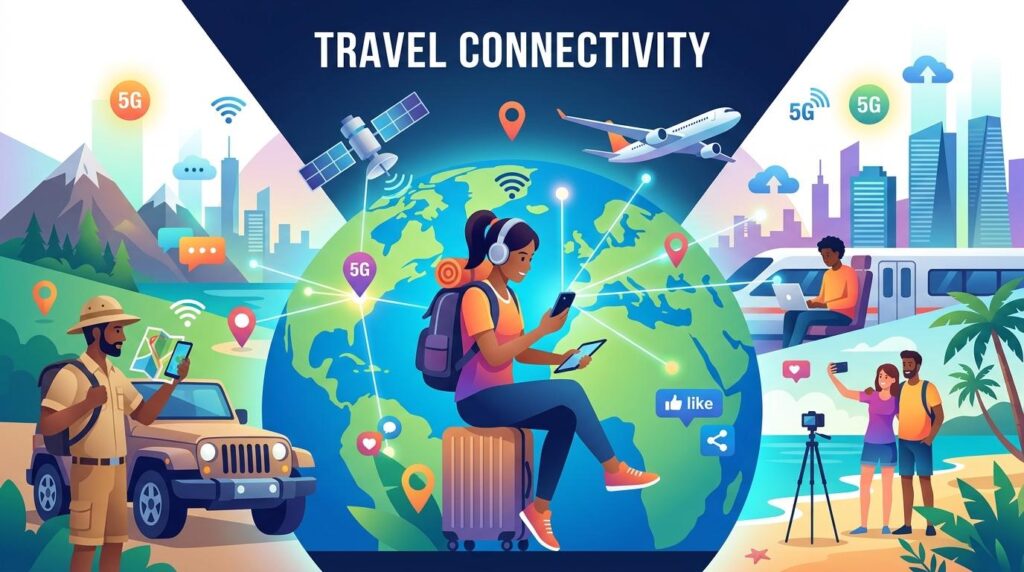
International travel has changed dramatically over the past decade. Smartphones have replaced paper maps, mobile apps have replaced many guidebooks, and digital payments have made it easier to move between countries without carrying large amounts of cash.
Now, another piece of travel technology is becoming increasingly important: the eSIM.
An eSIM, or embedded SIM, allows compatible smartphones and other connected devices to activate a mobile plan without requiring a traditional physical SIM card. For travelers, this seemingly small change can make staying connected across multiple countries considerably more convenient.
Instead of searching for a local SIM card after landing, travelers can increasingly prepare their mobile connectivity before leaving home. This shift is particularly useful for people taking multi-country trips, digital nomads working remotely, business travelers, and anyone who depends heavily on their phone while abroad.
What Is an eSIM and Why Does It Matter for Travelers?
A traditional SIM card is a small physical component that connects a mobile device to a cellular network. Changing networks or countries can therefore involve physically removing one SIM and replacing it with another.
An eSIM works differently. The SIM functionality is integrated directly into compatible hardware, allowing users to download and activate supported mobile plans digitally.
This changes the travel experience in several practical ways.
A traveler can potentially:
- Purchase a mobile data plan before departure
- Install the eSIM while still at home
- Keep their physical SIM card in the device
- Avoid searching for a SIM retailer at the airport
- Switch between supported plans when necessary
- Access mobile data shortly after arriving at a destination
The exact capabilities depend on the smartphone, carrier, country, and eSIM provider, but the broader trend is clear: mobile connectivity is becoming increasingly software-driven.
Why eSIM Technology Is Particularly Useful in Europe
Europe is an interesting environment for mobile connectivity because a single trip can involve several countries.
A traveler might begin in Spain, continue to France, spend a few days in Italy, and then travel through Switzerland or another destination. Historically, managing connectivity across multiple borders could mean researching different operators, purchasing additional SIM cards, or relying heavily on international roaming.
An eSIM can simplify that process.
Rather than treating every country as a separate connectivity problem, travelers can look for plans designed to provide coverage across multiple European destinations.
For people planning a multi-country itinerary, this can be more convenient than repeatedly changing physical SIM cards.
For example, someone taking a three-week European vacation could organize their connectivity before departure, install the appropriate eSIM, and then concentrate on the trip rather than finding a mobile shop every time the itinerary crosses a border.
The End of the Airport SIM Card Hunt?
For years, airports have been one of the most common places for international travelers to purchase local SIM cards.
The process is straightforward, but it is not always convenient.
After a long flight, travelers may have to:
There can also be language barriers, confusing plan structures, and limited choices.
With an eSIM, much of this preparation can happen before the trip.
That does not make physical SIM cards obsolete. They remain useful and widely supported. But eSIM technology gives travelers another option—one that is particularly attractive to people who value preparation and convenience.
Staying Connected Without Giving Up Your Primary Number
One of the most useful aspects of many modern smartphones is their ability to support multiple SIM configurations.
Depending on the device and carrier, a traveler may be able to retain their primary physical SIM while using an eSIM for mobile data.
This can be valuable because changing SIM cards traditionally meant temporarily removing the user’s regular SIM.
Keeping the primary SIM available can help travelers maintain access to their normal number for calls, messages, account verification, and other services, while using the travel eSIM for data.
However, users should check their phone’s specific dual-SIM capabilities and carrier settings before traveling. Compatibility is not identical across every smartphone.
How eSIMs Fit Into the Connected Traveler’s Toolkit
Modern travelers increasingly depend on their phones for far more than communication.
A smartphone can function as:
- A navigation device
- A boarding-pass holder
- A translation tool
- A digital wallet
- A hotel reservation manager
- A camera
- A travel guide
- A work device
- An emergency communication tool
That makes reliable mobile data more than a convenience.
Consider arriving in a new city and needing to find the correct train station. Without connectivity, the traveler may need to locate public Wi-Fi or ask someone for directions. With mobile data already active, they can open a map, check public transportation information, translate signs, and contact their accommodation immediately.
This is where eSIM technology becomes part of a broader trend: the smartphone is increasingly serving as the central operating system for modern travel.
eSIMs and the Rise of Remote Work
The growth of remote work has also changed the importance of international connectivity.
A vacation traveler might only need occasional data for maps and messaging. A remote professional may require connectivity throughout the day for email, video meetings, cloud applications, collaboration platforms, and authentication services.
Digital nomads face an even more complicated challenge because they may spend weeks or months moving between countries.
For these users, connectivity is not simply about convenience. It can directly affect their ability to work.
An eSIM can provide a flexible way to establish mobile data service when entering a new market, although professionals should always have a backup plan. Mobile coverage can vary by location, and an eSIM does not automatically guarantee the same performance everywhere.
For people traveling around Europe, a regional plan such as Holafly’s Europe eSIM can be one option to investigate when planning connectivity across multiple destinations.
What to Check Before Buying a Travel eSIM
Not every eSIM plan is identical.
Before purchasing one, travelers should look beyond the advertised amount of data and consider several practical factors.
1. Destination Coverage
First, check whether the countries on your itinerary are included.
A European trip can involve countries with different network arrangements, so do not assume that every European destination is automatically covered by every regional plan.
2. Data Allowance
Consider how you actually use your phone.
A light traveler who primarily uses messaging and occasional navigation may consume far less data than someone who regularly streams video, uploads large files, or works remotely.
3. Validity Period
Check how long the plan remains active.
A plan designed for a short vacation may not be appropriate for a month-long trip.
4. Network Availability
An eSIM provider generally partners with mobile networks rather than operating cellular infrastructure itself.
Consequently, the experience depends partly on the networks available in each destination.
5. Hotspot Support
This is especially important for remote workers.
If you plan to share your phone’s connection with a laptop or tablet, verify whether tethering or hotspot functionality is supported by the plan.
6. Device Compatibility
The phone must support eSIM functionality.
Most modern flagship smartphones offer eSIM support, but compatibility varies by model, market, and sometimes carrier configuration.
Checking the manufacturer’s specifications before purchasing can prevent an unpleasant surprise.
7. Activation Requirements
Some eSIMs activate immediately after installation, while others begin their validity period after connecting to a supported network.
Understanding when the validity period starts can help you avoid wasting travel days.
How to Install an eSIM Before Traveling
The exact process differs between Android and Apple devices, but the general workflow is relatively simple.
A typical process looks like this:
Step 1: Confirm compatibility
Make sure the smartphone supports eSIM and is not restricted from using another carrier.
Step 2: Purchase the plan
Select a plan appropriate for the countries, duration, and expected data usage of your trip.
Step 3: Receive the activation information
The provider normally supplies installation instructions, which may involve a QR code or an in-device activation process.
Step 4: Install the eSIM
Follow the phone’s cellular or mobile-network settings to add the new plan.
Step 5: Label the plans
If multiple SIMs are installed, give them clear names such as “Home” and “Travel.” This reduces the chance of selecting the wrong line later.
Step 6: Configure mobile data
Select the travel eSIM as the preferred data line when appropriate.
Step 7: Test the connection
If possible, confirm that the eSIM is installed correctly before leaving home. Depending on the plan, full activation may occur only after connecting to a supported network at the destination.
Common Mistakes Travelers Should Avoid
Despite the convenience of eSIMs, travelers can still run into problems if they configure their phones incorrectly.
Installing Without Checking Compatibility
One of the simplest mistakes is purchasing a plan before confirming that the device supports eSIM.
Always check first.
Turning Off the Wrong SIM
When managing multiple lines, travelers should carefully check which line handles calls, texts, and data.
A few incorrect settings can result in unexpected roaming charges.
Forgetting Data Roaming Settings
Some travel eSIMs require data roaming to be enabled for the eSIM line to connect. The correct configuration depends on the provider and device.
Assuming Every Country Is Covered
A regional label does not necessarily mean universal coverage.
Check the provider’s current destination list before purchasing.
Relying Entirely on One Connection
Even a good mobile plan cannot guarantee service in every tunnel, mountain region, rural area, or building.
Travelers who depend on connectivity for work should consider maintaining offline maps, downloaded documents, backup communication methods, and access to Wi-Fi when necessary.
eSIM Technology and the Bigger Digital Travel Revolution
The significance of eSIMs goes beyond replacing a piece of plastic.
It represents a larger shift in how connected devices interact with networks.
Traditional telecommunications relied heavily on physical infrastructure from the user’s perspective: physical SIM cards, retail stores, printed instructions, and manual configuration.
eSIM technology moves more of that process into software.
This creates opportunities for more flexible connectivity models.
The same trend is visible across the technology industry. Software-defined services are replacing or reducing the need for physical components in areas ranging from entertainment to financial services.
For consumers, the practical result is often simple: fewer physical objects and more control through software.
The Role of eSIMs in the Future of International Travel
As smartphones become increasingly capable, connectivity will likely become even more integrated into travel.
Future travelers may expect to purchase connectivity as easily as they book a hotel or download an app.
The distinction between “local” and “international” mobile service could also become less important from the consumer’s perspective. Instead, travelers may simply select a connectivity package based on where they are going and how long they will stay.
This could be particularly valuable for:
- Frequent international travelers
- Business travelers
- Digital nomads
- Students studying abroad
- Remote workers
- Long-term travelers
- Families visiting several countries
The underlying principle is convenience.
Travel technology works best when it removes friction rather than adding another task to an already complicated journey.
Are eSIMs Better Than Physical SIM Cards?
There is no universal answer.
Physical SIM cards remain useful, particularly for travelers using older devices or people who prefer traditional mobile plans.
However, eSIMs offer several advantages for international travel:
|
Feature |
eSIM |
Physical SIM |
|
Physical card required |
No |
Yes |
|
Can be installed before departure |
Often |
Usually requires obtaining the card |
|
Easy to switch plans |
Yes, on compatible devices |
Requires changing cards |
|
Risk of losing the card |
Low |
Possible |
|
Device compatibility |
Requires eSIM support |
Broad compatibility |
|
Useful for multi-country travel |
Often |
Depends on plan |
|
Installation |
Digital |
Physical |
The best option ultimately depends on the device, destination, carrier, and traveler’s preferences.
A More Convenient Approach to Connected Travel
Travelers no longer have to think about connectivity only after landing.
With eSIM technology, mobile service can become part of trip preparation alongside flights, accommodation, travel insurance, and itinerary planning.
That small change can have a surprisingly large impact.
Having connectivity ready when you arrive means you can immediately access maps, contact your hotel, check transportation information, communicate with family, and handle unexpected changes.
For modern travelers, that is more than a technological upgrade. It is a reduction in friction.
Final Thoughts
The evolution of travel technology is often about solving small problems that collectively make the entire experience easier.
eSIM technology is a good example.
It does not change where travelers go or what they experience, but it can change how easily they remain connected while moving between destinations. For travelers exploring multiple European countries, in particular, the ability to prepare mobile connectivity digitally can simplify an otherwise repetitive part of international travel.
As smartphones, digital services, and connected experiences continue to converge, technologies such as eSIMs are likely to become an increasingly normal part of the modern travel toolkit.
The future of travel may not simply be about getting somewhere faster. It may also be about making every stage of the journey—from planning to arrival—more seamless, flexible, and connected.